

Our Storytelling Series Features the Folks Most Associated With MSC’s History: Meet Judith LeBlanc

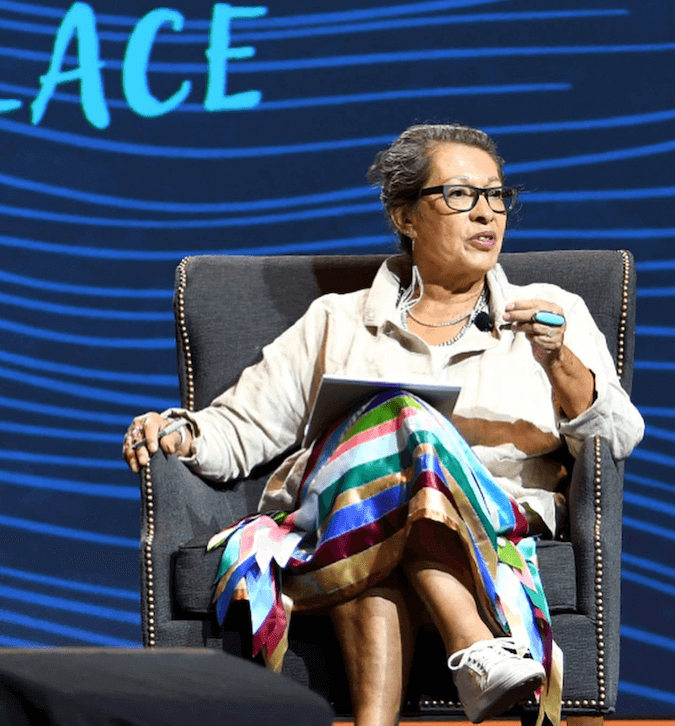
In this installment, we talk to Judith LeBlanc. She’s a citizen of the Caddo Nation of Oklahoma, Ekah’ (grandmother), activist, and member of the board for both MSC and NDN Collective. She’s previously served as a field director for Peace Action, national co-chair for United Peace and Justice, and a board member for Illuminative. She was a 2019 Roddenberry Fellow and a 2022 Resident Fellow at the Institute at Politics of Harvard Kennedy School. Since 2016, she’s served as the Executive Director of Native Organizers Alliance (NOA), a national network that taps into the political power of Native peoples and the wisdom of their ancestors to drive change in Indian Country.
“I’ve been able to witness two-and-a-half generations of people grow through many political moments, many political periods, and emerging through the other side as leaders, as people who are committed to social justice.”
LeBlanc has been a movement leader for almost 50 years: Her efforts span the Wounded Knee Defense/Offense Committee on the Pine Ridge Reservation in South Dakota in the 1970s to Standing Rock pipeline protests beginning in 2016 to the present battle to shutter a “detention facility” on Miccosukee Territory in the Florida Everglades.
Decades of activity in movement spaces means LeBlanc now finds herself working with some of the grandchildren of people she worked with in the 1970s, which helps shape her understanding of how important this work is for future generations. “The political conditions in which we are organizing and trying to interrupt the dominant narrative are going to take at least two generations to move the needle [and] repair the damage that has been done in less than a year by this administration,” LeBlanc remarked.
And that damage, LeBlanc said, is two-fold.
First, the dismantling of democratic structures, which includes attempts to do so on local and state levels. These efforts include the criminalization of bodily autonomy, attempts to redraw U.S. House districts in anticipation of midterm elections, book banning, and changes to anti-racism curricula in favor of “ending racial indoctrination.” Nationally, systemic racism continues to run rampant in the carceral system, healthcare, home ownership, education, and more. LeBlanc cites the elimination of diversity, equity, and inclusion (DEI) initiatives as a further contributor to the erosion. This includes the multi-pronged strategy of undermining sovereign nations to strip tribal nations of more land, water rights, and essential human services – treaty rights guaranteed by the U.S. Constitution.
Secondly, LeBlanc notes, is “the ideological impact of the dominant narrative that leads with the values of bigotry, division, violence, misogyny, racism, white nationalism, and right-wing religious fanaticism.” Tackling this narrative requires interrupting it with acts that value human rights, Mother Earth, and “interrupting with love,” she said. Following the 2016 election, LeBlanc participated in “Love in a Time of Violence,” a conversation moderated by Julie Quiroz of New Moon Collaborations. Discussing feelings of resilience, community, and determination, LeBlanc noted: “The wisdom that kept our people together even at the worst of times could be used as a guide for action even in the 21st century.” The folks opposing the construction of the Dakota Access Pipeline, she added, were called “protectors,” not “protestors” – a powerful example of how reframing a narrative can position grassroots organizers for success.
A Beautiful Entry Ramp
LeBlanc called MSC “a beautiful entry ramp” into relationships and understanding with a cross-section of communities, encouraging us to find our commonalities and solidarity in social justice causes. She was introduced to MSC a decade ago by founder Taj James and former co-director Mimi Ho. Sharing the belief that power building is only magnified when it’s in relationship to the struggle for grassroots advocacy across all communities, the three were among the participants in MSC’s Transitions Lab initiative, which gathered folks from across geographies and focus areas to generate models of democracy that nurture wholeness, community, power, mutual abundance, and justice.
Those spaces showed proof of the interconnected nature of movement building and confirmed the need activists have for space to connect and explore. The Transitions Labs also showed the holistic nature of the work – that there are “not only economic and financial needs but emotional and political needs.” Those concepts are core to the MSC’s ethos, and are equally important to LeBlanc and her work. She appreciates MSC’s consistent approach to bring together the threads of various social movements to provide spaces and places for collective, cross-sector action, thinking, hope – and power.
And as for building power? LeBlanc leads with values and a love for humanity and Mother Earth. Sure, many of us are angry, sad, scared, and reactive. But our power, she said, comes from people moving in balance; walking in beauty.
Drawing wisdom from Native ancestors, LeBlanc understands that while sometimes one must go head-on into battle, in order to achieve a truly inclusive multiracial democracy one must often find another path around an obstacle: “Sometimes you just have to be patient and understand the longer-term strategy of keeping our communities together, keeping them safe, keeping the spirits of people interconnected.”
Since 2001, MSC has been supporting narrative change work. “We live by stories,” MSC founder Taj James wrote in 2010, “by narratives that define and can shift our view of who we are alone to who we are together.” Throughout our conversation, LeBlanc made frequent mention of changing the dominant narrative.
Her relationship with MSC helped shape the way she and NOA approach their relationships beyond Indian country. She cites recent movements including Black Lives Matter, the push for immigrants’ rights, the Dreamers, and the Women’s March, that created the possibility for Standing Rock to “interrupt the dominant narrative of who Native people are in the 21st century.”
Interrupting the Dominant Narrative
LeBlanc, who is a regular contributor to Native News Online, wrote in July of the ongoing need to organize for an inclusive multiracial democracy where Indigenous sovereignty is respected and anyone who calls Turtle Island home can thrive. By working as a community, we’re creating pathways, she told MSC, to help our descendents create a truly multiracial society.
Her recent narrative work includes “Re-emergent Indigeneity in a Time Place of Collapse,” a three-part online series, with fellow activists Nāʻālehu Anthony and Norma Wong (an MSC mentor).
Over 2,000 people signed up for the calls, demonstrating just how hungry folks are for learnings around these holistic worldviews.
“The people we appeal to are the people who understand that they have a role to play.”
NOA is one of just a few Native-led nonprofits – and with less than 1% of philanthropic dollars in the U.S. explicitly benefiting Native Americans, coupled with the Trump administration’s ongoing efforts to undermine nonprofits at large and funders fearing retribution, shifting that narrative, building those circles of community, and funding that crucial work are more important than ever.
This summer, NOA worked with the National Native American Boarding School Healing Coalition (NABS), which cultivates healing for the profound trauma experienced by American Indian and Alaska Native Nations individuals, families, and communities around U.S. adoption and implementation of the Indian boarding schools. More recently, they’ve been involved in disaster relief efforts following the devastation wrought by Typhoon Halong, which has displaced thousands of Natives living on the southwest coast of Alaska. LeBlanc will be the keynote speaker at the 2026 UNITY Midyear Conference, an opportunity for over 700 Native American, Native Alaskan, and Native Hawaiian youth to participate in immersive training in community organizing and youth council development.
NOA’s narrative work is guided by what the “moccasins on the ground” need in order to build power to make change possible. Since the 2024 election, they’ve grown increasingly aware of how important it is to use language that brings people in, calls them to action, helps them understand their power – and to at least question the dominant narrative. “The people we appeal to are the people who understand that they have a role to play.”
Before President Biden left office in January 2025, NOA was among a robust network of allies who generated some quarter million letters calling for activist Leonard Peltier’s freedom. Peltier, a citizen of the Turtle Mountain Band of Chippewa in North Dakota, served nearly five decades in prison before the former president commuted his sentence on his last day in office.

NOA is heavily involved in efforts to close Alligator Alcatraz (yes, that’s its “official” name), the immigration “detention facility” located in the Florida Everglades. In addition to allegations of abuse and lack of due process, the facility was built on land that is sacred to the Miccosukee Tribe. Following an act of Congress, the tribe assumed control over their own affairs per an agreement with the federal government in the 1970s.
The tribe is now involved in a lawsuit against the state and federal government, stating the facility was built without environmental impact studies or tribal consultation. In addition to violating the Miccosukee’s tribal sovereignty, LeBlanc notes there are people across the political spectrum concerned about the facility’s environmental impact.
LeBlanc called this one of the most important struggles and it demonstrates the interconnection of our common existence on Mother Earth. Indeed, William Osceola, the Miccosukee Tribe’s secretary, remarked the existence of Alligator Alcatraz “feels like history is not slowly repeating, but echoing … There’s this facility where you’re trying to round up individuals who do not look like them, that they say do not belong here, and they’re not part of their country. And just looking at tribal history, that’s the whole basis of the reservation system in this land.”
The existence of this facility impacts immigrants’ rights and dignity, environmentalists, tribal leaders, and many others working at the intersections of racial, climate, and carceral justice: Shifting a dominant narrative that claims some human beings are “illegal,” denies the existence of science, and continues to ignore the impacts of systemic racism will be long fight, LeBlanc acknowledges.
“We came to their support to build online pressure on the administration and continue to do so, because it’s going to take years to shut that place down … We came to their aid because it was the coming together of the tribe standing on its sovereignty, its legal rights, and fighting for it in the courts.” She added that “dramatizing the long-term environmental impact of this concentration camp on the environment – to endangered species, to the vegetation, and also to its sacred places,” was crucial.
The Long View
At this moment in history, we can’t fully trust the checks and balances that (mostly white) Americans believed in for over two centuries. Native people and other people of color have a much deeper understanding that we can’t fully trust in a system that has abused, killed, marginalized, and “othered” them and their ancestors for centuries. However, LeBlanc notes, Native peoples have spent hundreds of years building up a resilience to ensure Indigeneity as a worldview endures despite attempts to eliminate Native culture, languages, beliefs, sacred ceremonies, and ways of life.
“There are people with discerning hearts and minds who can pick from the past what is useful in order to strengthen the movements for social justice.”
That long view is crucial. And it aligns with MSC’s 100-year vision where, over generations, we strategically navigate toward a future where the many govern for the benefit of all. Further, we must evolve the methods we use to shift the paradigm. “We have to change the way we fight … We need to use language that calls people in. We can’t solely depend on lawsuits, or voting, or protests.” LeBlanc believes we must “respond, not react,” and seek “medicine for what is causing so much pain.”
In the present moment, the key to coping with the daily bombardment of the illegal and immoral actions of the federal government is having a community in which we can share a common vision, reflect, and make plans for collective action, LeBlanc shared. She acknowledges that MSC creates circles for reflection and opportunities for cross-pollination on plans and action, and hopes other fiscal sponsors follow suit. “Over and over again,” grassroots action has made all the difference in the long run: “It’s the way big social change happens – has always happened, from the beginning of time.”
“That’s why I do what I do,” LeBlanc said. “I also am very optimistic, because I believe there are answers from our collective history, all the peoples that live on Turtle Island. There are people with discerning hearts and minds who can pick from the past what is useful in order to strengthen the movements for social justice. It is about the survival of humanity and the survival of Mother Earth … In our ceremonies, we’re not praying for our tribes, we’re praying for humanity.”
You can follow Native Organizers Alliance on Facebook, Instagram, and LinkedIn. If you are able, consider making a gift in support of their ongoing mission.