

A Nine-Month Cohort Culminates with a California Retreat
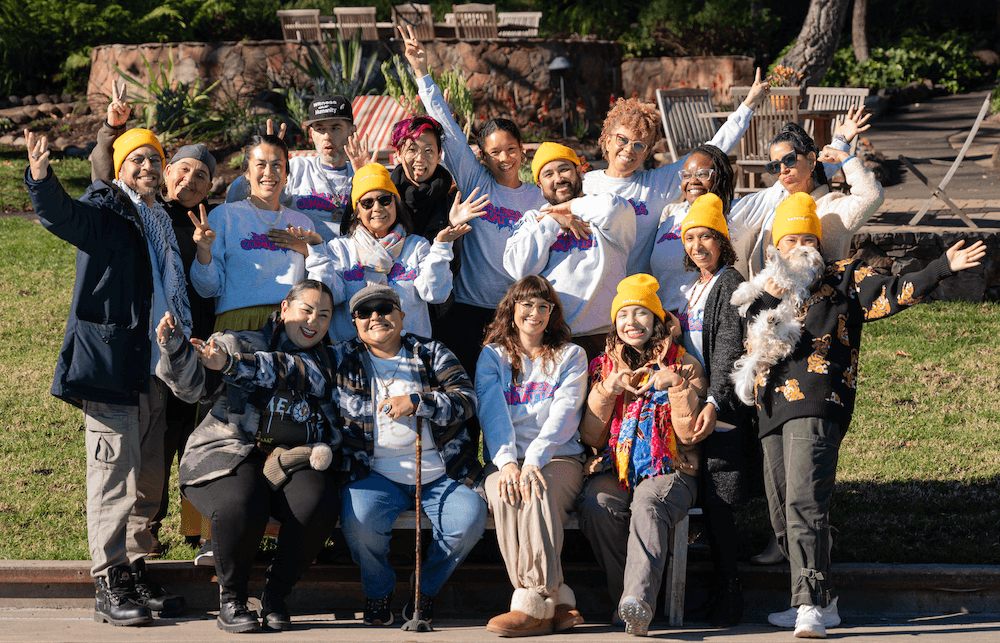
Beloved Communities Network (BCN), a Movement Strategy Network member, builds upon decades of transformative practice inspired by the legacy of Dr. Martin Luther King Jr., the Fellowship of Reconciliation, and Grace Lee Boggs while remaining focused on transitioning from a world of violence, domination, and extraction to one of love, resilience, and regeneration. BCN began with Transitions Labs, MSC’s generative convenings designed to explore and inform intentional transformation for collective wellbeing. The connections and embodied practices cultivated in these labs live on through BCN’s work.
As defined by Movement Strategy Center’s Glossary of Terms, Beloved Community “describes a society built on economic and social inclusivity, a community in which everyone is cared for, absent of poverty, exploitation, and hate.” It is not a utopian ideal, but both a destination and a way forward. To that end, BCN recently completed their first Beloved Communities Cohort in collaboration with MSC. The nine-month program brought together nationwide movement leaders rooted in transformative work, with the intention of building community through monthly online engagements and culminating with an in-person retreat.
After nearly a year of deep, transformative work, participants convened in person during the four-day retreat. Cohort member Yesenia Veamatahau, Director of Integration at Resonance Network, noted: “These were mostly people I had never met in person before, yet I felt that we could come together from our core selves and be in an imaginative, creative, caring, and tender space.” The retreat showcased and taught what it means to be in Beloved Community with others; as shared by another member, Bethsaida Ruiz Natal, Core Leader at Thrive Network, “served as a reminder that Beloved Community is not just a theory or a practice — it is something we live into, something we build with our presence, our openness, and our willingness to see and be seen.”
Moved by these reflections, MSC sat down with Leila McCabe-Williams, Executive Director of BCN, to talk about the retreat and what’s next.
This interview has been edited for length and clarity.
MSC: Could you give us a brief overview of the Beloved Communities Cohort?
Leila McCabe-Williams (LMW): We brought together about 20 individuals that were either fiscally sponsored by MSC, incubated under BCN and Full Spectrum Labs, or on staff at MSC, for a nine-month cohort. Throughout the cohort, we met over Zoom for sessions that followed our “10,000 Beloved Communities” graphic novel and guide. Our work at BCN is rooted in the principles laid out in the graphic novel, and we followed the arc of those eight elements in the cohort’s curriculum, focusing on one each month. Our virtual meetings included monthly “practice sessions” where we primarily focused on how we embody these elements, and the role embodiment plays in Transformative Movement Building. After nine months of being together over Zoom, the cohort culminated in an in-person retreat.
MSC: Where was the retreat held?
LMW: We held the retreat in Sonoma, Calif., at a center called Westerbeke Ranch. The ranch has been used by folks at MSC before, though I had never attended an event there. When I went to see it, I thought, “this is a beautiful place,” but the space also provided an environment set away from the hustle and bustle of every day life and allowed cohort members to be fully present in the work.

MSC: Can you walk us through some of the activities that you did during the retreat?
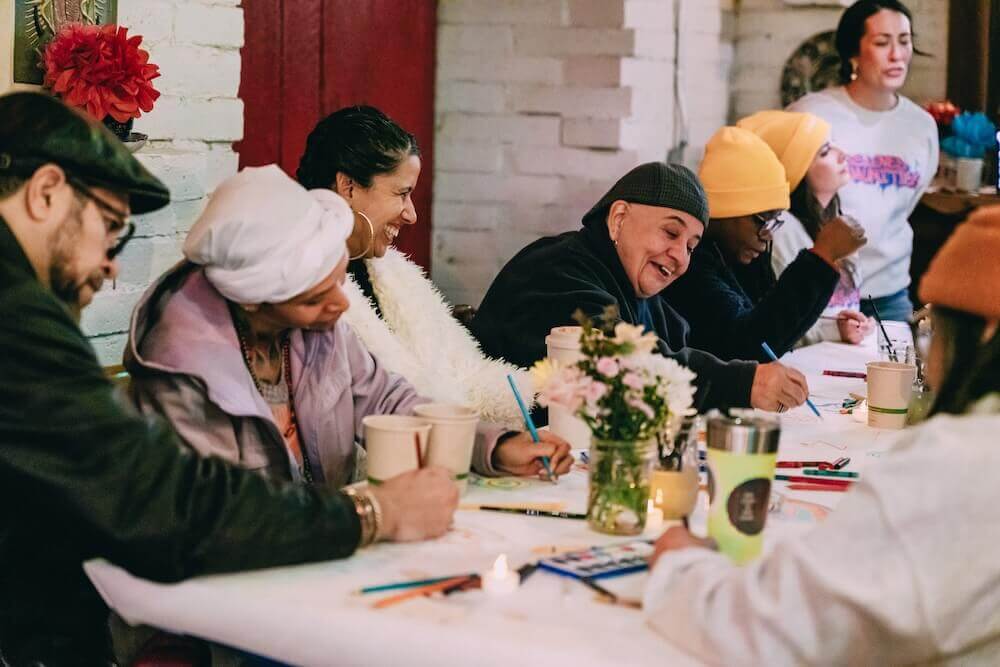
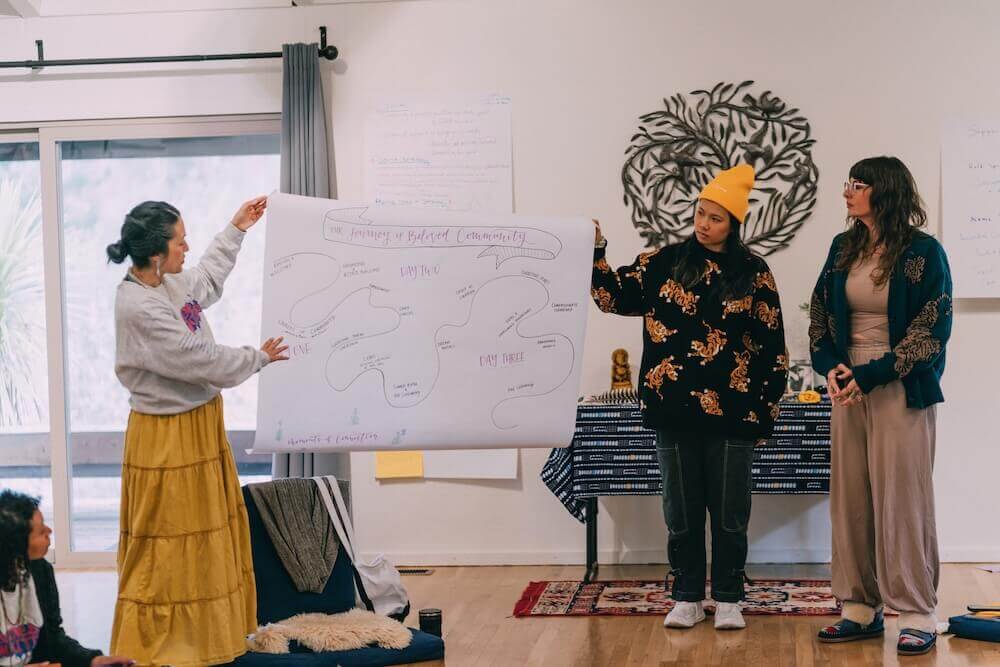
LMW: The retreat featured a range of activities grounded in the key practices and concepts of Beloved Community, as outlined in the graphic novel. We opened and closed with an altar ceremony, creating sacred space for the work. Throughout the retreat, participants engaged in transformative exercises centered on the 8 Elements of Beloved Community. These exercises supported relationship building, creativity, visioning, navigating challenges, and developing strategies to integrate Beloved Community principles into their personal lives, families, communities, and work.
"There was a strong sense of unshakable belonging, which is truly the foundation of Beloved Community."
MSC: Talk a little bit about what made this a retreat as opposed to a training or a learning session. Or do you see those as one in the same?
LMW: I think they’re used interchangeably for us. It was more about time spent together to learn collectively. Sophie [Hou, MSC’s Director of Innovation and Strategic Initiatives] and I called ourselves “facilitants” because we were both facilitating and participating in this cohort. We don’t have all the knowledge and answers to everything, and there was a collective knowledge and depth from everyone who participated in this.
As far as the retreat, we did have some concepts and outcomes in mind. One of those outcomes was creating a nourishing space for people to be in relationship with each other. That was intentionally built into the design of the retreat so people would be able to leave and apply the practices of cultivating Beloved Community in their own communities.
MSC: Was there a moment during the retreat where you started to see any of the 8 Elements of Beloved Community emerge among cohort members?
LMW: I was honestly a bit surprised by how quickly a sense of belonging took root in this cohort. We spent nine months on Zoom — which can make it difficult to build deep relationships — but even in that virtual space, there was a strong feeling of unshakeable belonging, which is truly the foundation of Beloved Community. By the time we arrived at the retreat, those connections were already so deep that no groundwork was needed. People simply embraced each other, thrilled to finally be together in person.
The first question we asked was, “Do you have a curiosity or a hope for what might emerge from this retreat?” Remarkably, about 90% of the responses were about staying connected beyond the retreat. That speaks volumes. There was a deep sense of trust and safety, and it was from that foundation that cohort members were able to enter into ceremony together with real vulnerability. It was intense, profound, and deeply meaningful.
MSC: How will/have cohort members stayed in touch with each other post-retreat?
LMW: We’re intentionally working to build long-term connections among cohort members, both from this cohort and future ones, through virtual platforms and digital tools. For example, we created a WhatsApp group where members continue to engage regularly. There’s even a smaller, California-based group that gathers in person for events and mutual support. People check in, share love notes and poems — it’s really beautiful. While we helped create the initial container, it’s being sustained organically by the participants themselves. At BCN, we plan to keep nurturing these relationships through shared calendars and community platforms that support continued connection.
MSC: What would you do differently for the next cohort? What would you keep the same?
LMW: One clear takeaway is the power of in-person connection. While the relationships we built over nine months on Zoom were deep and strong, several cohort members shared that they wished we had met in person earlier. So, we’re exploring how to bring people together midway through the program to strengthen that sense of connection and belonging earlier on. We’re also revisiting the structure and pacing of the sessions: Is it more effective to meet once a month for nine months, or twice a month for a shorter span? These are the kinds of questions we’re holding as we design future cohort programs.
From the beginning, we’ve approached this work with a commitment to learning and growth. The evaluation process we conducted with cohort members was incredibly moving. People responded with such care, honesty, and depth. Their reflections brought us to tears. We’re taking their insights seriously, and will continue to shift, pivot, and optimize based on what we learn.
We’re deeply committed to growing this work by bringing together more cohorts and refining the experience each time. Practice sessions outside of the content modules will be a bigger focus moving forward. We plan to continue weaving in guest facilitators from our broader ecosystem, like Kristen Zimmerman, author of “10,000 Beloved Communities,” who brought such richness this year. Every cohort is an opportunity to learn, deepen, and build Beloved Community in more expansive and intentional ways.
MSC: How can people stay connected and informed about your work going forward?
LMW: People can get in touch with us directly on our website, or can follow us on Instagram, LinkedIn, and Facebook. We’ll use those channels to announce when the application for the second Beloved Community Cohort program opens.
If you are able, consider sharing a gift that sustains the heart of BCN’s work in building Beloved Community. You can support their efforts by donating here.
